Curriculum
Digital Marketing Fundamentals
Foundations & Context (1-2)
0/2

Strategy & Plannning (3-4)
0/2
Core Digital Channels & Relationships (5-10)
0/6
Measurement, Ethics & the Future (11-12)
0/2
D1. Welcome to Digital Marketing
1.0 Opening Scenario: A Day in Your Digital Life
 It’s Monday morning.
How does the first fifteen minutes of screen time after you wake up in the morning look like? I have asked my students this question often. The responses are always the same — a cascade of notifications, ads, recommendations, and reminders. Most of them don’t realize how much marketing they’ve already consumed before breakfast.
On your lock screen, you may see a notification from a food delivery app: “Start your week with 20% off breakfast deliveries.” You don’t think of this as “a targeted push notification executed by a marketing automation platform.” You think to yourself, “Maybe I don’t have to cook this morning.” You tap it, glance at the offer, and make a mental note, but you decide to eat at home. The app still learned something: you opened the message, looked at the options, and closed it. That small behavior will be reflected on someone’s dashboard later.
On the way to campus, you listen to a podcast. Halfway through, an ad for a language-learning app begins to play. The host doesn’t just read a generic script; they tell a little story about using the app during their commute. You’ve heard the brand name before on YouTube, and you’ve seen its ads in your social feed. You’re not interested enough to download it yet, but whether you realize it or not, the brand is slowly building awareness and familiarity through multiple digital touchpoints.
You arrive on campus, open your laptop, and check your email. Your favorite clothing brand announces a “limited-time sale” and recommends items “based on your past purchases.” A streaming service nudges you with, “Continue watching the show you started this weekend.” Your bank sends a message about fraud alerts and “upgrading to our new app experience.”
Each of these emails has been carefully crafted, tested, and scheduled by experienced marketers. The subject lines were likely A/B tested. The layout and call-to-action buttons were chosen because an earlier design had performed slightly better in terms of click-through rates. To you, it’s just your inbox. To the companies sending the messages, it is part of a carefully designed customer journey.
In your first class of the day, the professor mentions a new textbook. You haven’t bought it yet, so you open your laptop and search for the title. Google displays a mix of organic results — publisher websites, Amazon product pages, and Chegg-like sites — and shopping ads with prices from different vendors. You compare prices, delivery times, and the options of used versus new. You read a couple of reviews.
In a few minutes, you have accomplished what would have taken hours or days just a generation ago: gathering information, comparing alternatives, and making a purchase decision. Along the way, multiple digital marketing tools were at work. Search engine optimization (SEO) helps particular sites appear near the top. Paid search ensures that the publisher’s or retailer’s ad appears for that exact book title. Recommendation engines suggest “Students also bought…” accessories. You might not notice any of that. You simply think, “I found a good deal on the book.”
At lunch, you and a friend are trying to decide where to eat. You open a maps app and search “Thai near me.” A list of nearby restaurants appears. Some have photos, menus, and hundreds of reviews. Others have no pictures, few reviews, and incomplete information. You don’t say, “This restaurant has clearly invested in local SEO, review management, and listing optimization.” You choose the one that looks appealing, has good ratings, and shows it is open.
Under the surface, someone has claimed and optimized the restaurant’s business listing, uploaded photos and menus, encouraged happy customers to leave reviews, and responded to negative feedback. That work is part of digital marketing, even though it does not look like an ad.
In the afternoon, while “studying,” you take a short social media break. You scroll past a funny video from a friend, an influencer reviewing a skincare product, a brief clip of a new video game, a sponsored post from a local gym you have never heard of, and a viral meme that includes a brand’s logo in the corner. Some of this is organic content — people sharing with friends. Some of it is paid. Some of it is a mix, where an influencer is being paid or given free products, but the post is styled to look like regular content.
You pause to watch the game trailer twice. A few minutes later, you see an ad for the same game on another platform. Coincidence? Probably not. Behind the scenes, the game’s marketing team is running targeted campaigns. Pixels and cookies help them recognize that you have shown interest, and they “follow” you across platforms with ads. Marketers call this retargeting. Again, you do not think, “I am moving deeper into the marketing funnel.” You think, “That game actually looks pretty good.”
In the evening, you order groceries through an app. As you check out, the app suggests items you might also like, frequently bought together items, and bundles that offer a better deal. These suggestions are not random. They are driven by data: purchase histories, patterns, and algorithms. They represent an ongoing effort to increase basket size and customer lifetime value, while also ideally being helpful to you.
Later that night, you finally watch the show that the streaming service recommended in the morning. After a few episodes, the platform updates its recommendation engine, making slight adjustments to what it will show you next. Your viewing becomes a small input into a much larger model of what people with similar tastes might like.
By the time you go to sleep, you have seen dozens of digital ads, many of which you did not consciously register. You have interacted with multiple websites, apps, and emails. You have generated data that will inform future marketing decisions.
You might describe your day as “just a normal Monday.” A digital marketer sees something else: a series of customer journeys unfolding in parallel; multiple digital channels working together (or sometimes against each other); and streams of data and feedback that can be used to improve experiences, refine offers, and allocate budgets.
In this book, you’ll learn to view the digital world more like a digital marketer — not as a jumble of apps and ads, but as a set of strategies, tools, and decisions designed to connect offerings with the right people at the right time. You’re not just studying digital marketing. You’re living inside it every day. Our task is to step behind the screen and understand what’s actually driving what you see.
1.1 Learning Objectives
After you read this chapter and complete the accompanying activities, you should be able to:
- Explain what digital marketing is in clear, everyday language.
- Recognize how digital marketing builds on traditional marketing principles, such as the 4Ps and segmentation, targeting, and positioning (STP).
- Identify the common digital touchpoints you encounter throughout a typical day and describe how they shape the customer experiences.
- Use a simple customer journey model — awareness, consideration, purchase, post-purchase, and advocacy — to understand how marketing activities fit together.
- Differentiate among major types of digital channels, including websites, search engines, social media, email, and apps.
- Describe the role of data and feedback in shaping digital marketing decisions.
- Understand how this textbook and course are organized, and how the ideas introduced in this chapter lay the groundwork for the chapters that follow.
1.2 What Is Digital Marketing?
 Digital marketing is the practice of marketing in digital spaces, including search engines, social platforms, email, apps, marketplaces, and websites. The purpose remains unchanged: to understand customers, create value, communicate clearly, and foster repeat relationships. What has changed is the setting — and with it, the speed of feedback, the ease of comparison, and the way algorithms shape what people notice. When you search online for a nearby restaurant, read reviews, or check whether a place is open, you are interacting with digital marketing even if you do not think of it that way. The same is true when you encounter a sponsored post on social media, see a personalized offer in your inbox, or watch a video recommended “because you viewed something similar.” I once interviewed a small restaurant owner who told me that a single unanswered Google review cost him more business than a bad Friday night rush. That’s how tightly digital behavior and real-world outcomes are now intertwined. These moments illustrate how digital marketing fits into the fabric of everyday life. They are small interactions, often measured in seconds, but they influence awareness, consideration, and the choices people make.
Digital environments behave differently from billboards and TV spots because customers can respond instantly — and you can measure it. People click, swipe, bounce, share, ignore, and leave a trail of signals along the way. That measurability is a gift, but it can also trap teams into obsessing over what’s easy to count instead of what actually matters.
None of this replaces traditional marketing. It repackages it in a world where the “storefront” is a search results page, the “salesperson” might be a recommendation engine, and the “word-of-mouth” is a review feed that never sleeps.
Digital marketing applies familiar principles in a world where customers move fast, compare instantly, and expect relevance. Across this book, you’ll learn how channels support different stages of a journey — and how data helps marketers understand what’s working. But don’t reduce digital marketing to hacks or platform tricks. It’s marketing in a connected, data-rich environment where feedback arrives quickly, and choices multiply.
1.3 How Digital Fits into Basic Marketing Concepts
Digital marketing may seem like a collection of new platforms, tools, and tactics, but its foundations remain firmly rooted in traditional marketing. The core ideas you may remember from an introductory course — the 4Ps, segmentation and targeting, and the importance of creating value — still guide decision-making. What changes in a digital environment is how these familiar ideas take shape. The frameworks stay the same, but the tools become more flexible, interactive, and measurable.
The 4Ps in a Digital Context
The marketing mix — product, price, place, and promotion — remains a helpful way to understand the decisions marketers make. Digital technologies influence each element in ways that expand what is possible.
A product may now include digital features, such as an app that complements a physical device or a subscription that unlocks updated content. Price is shaped by customers’ ability to compare options instantly, by dynamic or personalized pricing models, and by subscription plans that depend on digital delivery. Place extends to websites, mobile apps, and online marketplaces where customers browse, purchase, or pick up their orders. Promotion evolves from one-way messages to interactive content, search visibility, personalized email, and targeted advertising. The questions behind the 4Ps remain the same, but digital environments offer new answers.
STP in a Digital Environment
You should be familiar with STP (segmentation, targeting, and positioning) from your Marketing Foundations course. Marketers use STP to identify which audiences to reach and how to appeal to them. Digital environments enrich this process by providing more information and more precise tools.
Search queries, browsing patterns, and social interactions provide valuable insights into what customers care about. Digital platforms enable the targeting of messages to individuals in specific locations, with particular interests, or those who have exhibited past behaviors that suggest a need or preference. Positioning also takes new forms: a brand can shape its identity through website design, search engine results, social media content, online reviews, and the tone of its communication. The digital context allows for finer distinctions among audiences, but the purpose remains familiar — understanding customers and speaking to them in a way that resonates.
The Rise of Omnichannel Marketing
A customer’s experience rarely unfolds in a single place. A person might discover a product on social media, read reviews on a mobile app, visit a physical store to see it in person, and later make the purchase online. From the customer’s point of view, these steps are all part of one continuous journey, not a series of disconnected interactions. Marketers describe this integrated perspective as omnichannel marketing.
Omnichannel marketing recognizes that digital and physical touchpoints are no longer separate worlds. A clear message on a website should align with the information provided by in-store associates. A mobile app should reflect the current inventory. A loyalty program should function seamlessly whether customers shop online or in-store. The goal is to create a seamless experience that enables customers to transition easily across channels without encountering friction or confusion.
Traditional Foundations, Digital Execution
These examples demonstrate that digital marketing is an extension of traditional principles, not a replacement. The goals — understanding customers, delivering value, communicating effectively, and building relationships — remain the same. Digital tools make the work faster, more testable, and far more visible.
As we progress through this book, we will continue to connect digital tactics to familiar ideas. We will explore how various digital channels support the customer journey and how data enables marketers to refine their decisions. Digital marketing may take place in a connected, fast-moving environment, but at its core, it remains the practice of helping the right customers find the right offerings at the right time.
1.4 A Simple Map: Journeys, Channels, and Data
One helpful way to think about digital marketing is in terms of a customer journey — the path a person follows from first becoming aware of an offering to forming longer-term opinions and relationships with a brand. Customers do not always move neatly from one stage to the next, and they may skip steps or revisit earlier ones. Still, the idea of a journey provides a helpful map for understanding how digital marketing fits into everyday decision-making.
The Customer Journey
When I have mapped customer journeys with executives, the biggest surprise has always been the same: the journey rarely starts where they think it does. Customers begin forming impressions long before the company realizes it. The journey usually begins with awareness. Someone might encounter a brand through a social media post, a short video recommended by an algorithm, or a search result that appears while they are looking for something else. At this stage, the person may not be actively shopping; they are simply becoming aware that an option exists.
From there, people often move into consideration. They may visit a website, read online reviews, watch comparison videos, or ask friends for recommendations. For example, a student searching for a laptop might explore several manufacturer websites, read customer reviews, and watch YouTube videos that compare features and prices. Digital marketing plays a role by making relevant information easy to find and understand.
A decision to buy leads to the purchase stage. This may happen entirely online, through a website or mobile app, or it may occur in a physical store after online research. A customer might research a product on their phone, receive a reminder email or see a targeted ad later, and complete the purchase when the timing feels right. The design of the checkout process, the clarity of information, and the availability of support all influence whether the transaction is completed smoothly.
After the purchase, the journey continues into the post-purchase stage. Customers receive order confirmations, shipping updates, or instructions for using the product. A software company might send onboarding emails, while a retailer might provide easy access to returns or customer support. These interactions shape how customers feel about their decision and whether they trust the brand in the future.
Over time, positive experiences may lead to advocacy. Satisfied customers may leave reviews, recommend the product to friends, or share their experiences on social media. These actions, while not always intentional marketing efforts on the customer’s part, influence future buyers and help restart the journey for others.
Figure 1.1 – The Customer Journey
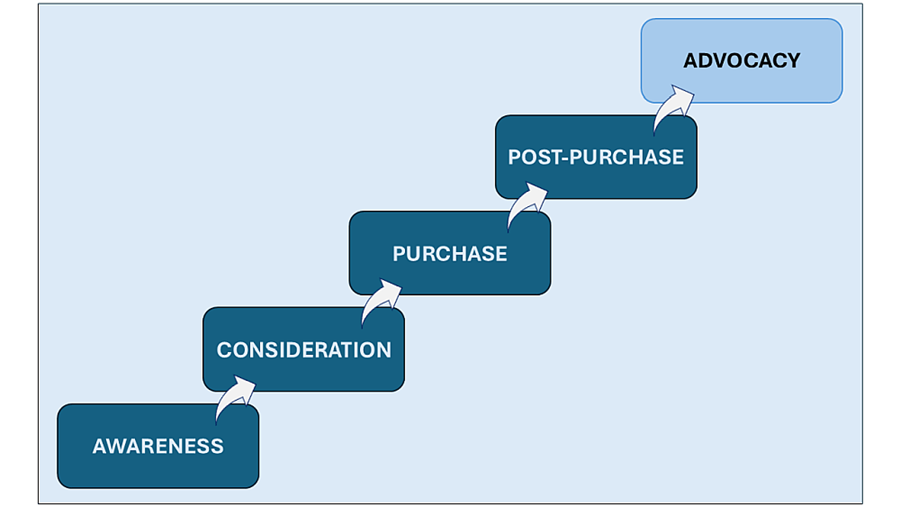
Note: The Customer Journey is not an inalienable path; sometimes stages are skipped, depending on several factors. The “Advocacy” stage is highly desired, but not always attainable.
Digital Channels Along the Journey
Different digital channels are more visible or influential at various points in the customer journey. Social media and online video often play a role in building awareness, while websites, reviews, and comparison tools support consideration. Email, mobile apps, and checkout interfaces influence the purchase experience, and post-purchase communication often relies on email, support platforms, or community forums.
These channels rarely operate in isolation. A person might first encounter a brand on social media, later search for it online, visit the website, read reviews on a third-party platform, and finally download the app. Digital marketing involves understanding how these touchpoints connect and how they collectively shape customer experience.
The Role of Data and Feedback
What distinguishes digital marketing from many traditional approaches is the availability of continuous feedback. I once worked with a retailer who changed a single line of copy in their checkout flow and saw a 9% lift in conversions overnight. That kind of immediate feedback didn’t exist twenty years ago. Each interaction — a click, a search, a page view, or an email open — provides information about how customers are responding. This data does not replace judgment or creativity, but it helps marketers learn what works and what doesn’t.
For example, a company may notice that many visitors leave a website at the same point, suggesting confusion or friction. It may test two versions of an email to see which one leads to more engagement. Over time, these observations enable marketers to refine their decisions and enhance the customer experience. The process is ongoing, creating a feedback loop in which learning and adjustment become part of everyday marketing practice.
The concept of journeys, channels, and feedback provides a straightforward framework for understanding digital marketing as a whole. Throughout this book, we will return to this map as we explore specific tools and techniques. Each chapter will add detail, but the basic logic remains the same: understanding how people move through digital environments, how organizations reach them, and how learning from data helps marketing evolve.
1.5 Why Digital Marketing Matters Now
Digital marketing matters because it’s where people actually make decisions now. As digital tools became part of everyday life, marketing had to adapt to new expectations, behaviors, and competitive realities. For modern marketers, digital marketing isn’t optional — it’s baseline competence.
One reason digital marketing matters so much is simple: we spend a significant amount of time on screens. Think about the last three days — how many times did you look something up, check a rating, scan a menu, compare prices, or watch a quick “how-to” before doing something? Most of us underestimate how often we rely on digital tools because it feels like breathing.
Digital marketing also offers a level of measurability and accountability that was difficult to achieve with many traditional media. Marketers can observe how people arrive at a website, which messages capture their attention, where customers tend to disengage, and which interactions lead to the desired outcomes. This visibility allows organizations to move beyond intuition alone and make decisions informed by evidence. While data does not eliminate uncertainty, it enables learning, experimentation, and improvement in ways that were previously impractical.
Another critical factor is the ability to deliver targeted and relevant communication. Digital tools enable the tailoring of messages and experiences to different audiences based on their interests, context, or past behavior. When done thoughtfully, this relevance benefits both sides: customers receive information that is more useful to them, and organizations allocate their resources more effectively. At the same time, this capability raises questions about privacy, transparency, and ethics — issues that will be addressed later in this book.
The digital environment is also dynamic and fast-moving. Platforms evolve, consumer habits shift, and new tools emerge regularly. This constant change can feel overwhelming, but it also rewards organizations that are willing to learn and adapt to it. Rather than relying on fixed campaigns planned months in advance, digital marketing often emphasizes testing, iteration, and responsiveness. Marketers are expected to monitor performance, learn from results, and adjust their approaches over time.
Digital marketing further enables reach and scalability that were once available only to large organizations. A small business, nonprofit, or individual creator can now reach national or global audiences through a website, social media presence, or online marketplace. While digital access does not guarantee success, it lowers barriers to entry and increases competition, making strategic thinking and differentiation even more critical.
Ultimately, digital marketing matters because it is increasingly integrated with other business functions. Marketing decisions influence, and are influenced by, product design, customer support, operations, and data analytics. Insights gained from digital interactions can inform improvements across the organization, from refining offerings to enhancing customer service. In many firms, digital marketing serves as a central source of insight into customer needs and experiences.
Taken together, these factors explain why digital marketing has moved from the periphery to the center of modern marketing practice. It reflects changes in technology, consumer behavior, and business strategy that are unlikely to reverse. For students of marketing, learning digital marketing is not about mastering a specific platform or tool; it is about understanding how marketing principles operate in a connected, data-rich environment and developing the ability to adapt as that environment continues to evolve.
Summary
This chapter frames digital marketing as the environment in which marketing now occurs. Using everyday examples, you saw how digital touchpoints shape awareness, decisions, and post-purchase experiences throughout a typical day. Digital marketing isn’t a separate discipline — it’s traditional marketing principles playing out in connected, data-rich spaces.
You also connected digital marketing to the basics you already know: the marketing mix and STP. Digital tools expand what’s possible, but the goals stay stable — understand customers, create value, and build relationships. The customer journey provides a simple map: awareness, consideration, purchase, post-purchase, and advocacy. People bounce around these stages and use multiple channels, which is precisely why marketers think in terms of journeys rather than isolated tactics.
Last, you saw why digital marketing sits at the center of modern practice: the speed of change, the measurability, the ability to tailor communication, and the way marketing is now tied to product, operations, support, and analytics. If you can read the signals and respond with judgment, you’ll be effective — regardless of platform.
Key Terms
· Advocacy Customer behaviors such as reviews, recommendations, or social sharing that influence others.
· Awareness The stage at which a customer first becomes conscious of a product, service, or brand.
· Consideration The stage in which customers gather information, compare alternatives, and evaluate options.
· Customer Journey The path a customer follows from awareness through consideration, purchase, post-purchase experience, and potential advocacy.
· Digital Marketing The practice of applying marketing principles in digital environments where customers search, interact, and make decisions online.
· Feedback Loop The process of learning from customer interactions and using that information to refine marketing decisions.
· Marketing Mix (4Ps) A framework consisting of product, price, place, and promotion that is used to guide marketing decisions.
· Omnichannel Marketing An approach that integrates digital and physical touchpoints to create a seamless customer experience.
· Post-Purchase Experience The interactions that occur after a purchase, including support, communication, and usage of the offering.
· Purchase The point at which a customer decides to buy and completes a transaction.
· Segmentation, Targeting, and Positioning (STP) A framework for identifying customer groups, selecting which groups to serve, and shaping how an offering is perceived.
Reflection Questions
1. Think about your own day. What are three examples of digital marketing you encountered without actively seeking them out?
2. How does the idea of a customer journey help explain the way people move between websites, apps, and physical stores?
3. In what ways does digital marketing make traditional marketing principles more visible or measurable?
4. Why is digital marketing not simply about learning specific platforms or tools?
5. How might digital marketing create both opportunities and challenges for consumers?
6. Consider a recent purchase you made. Which digital touchpoints influenced your decision, and at which stages of the journey?
— End of chapter —